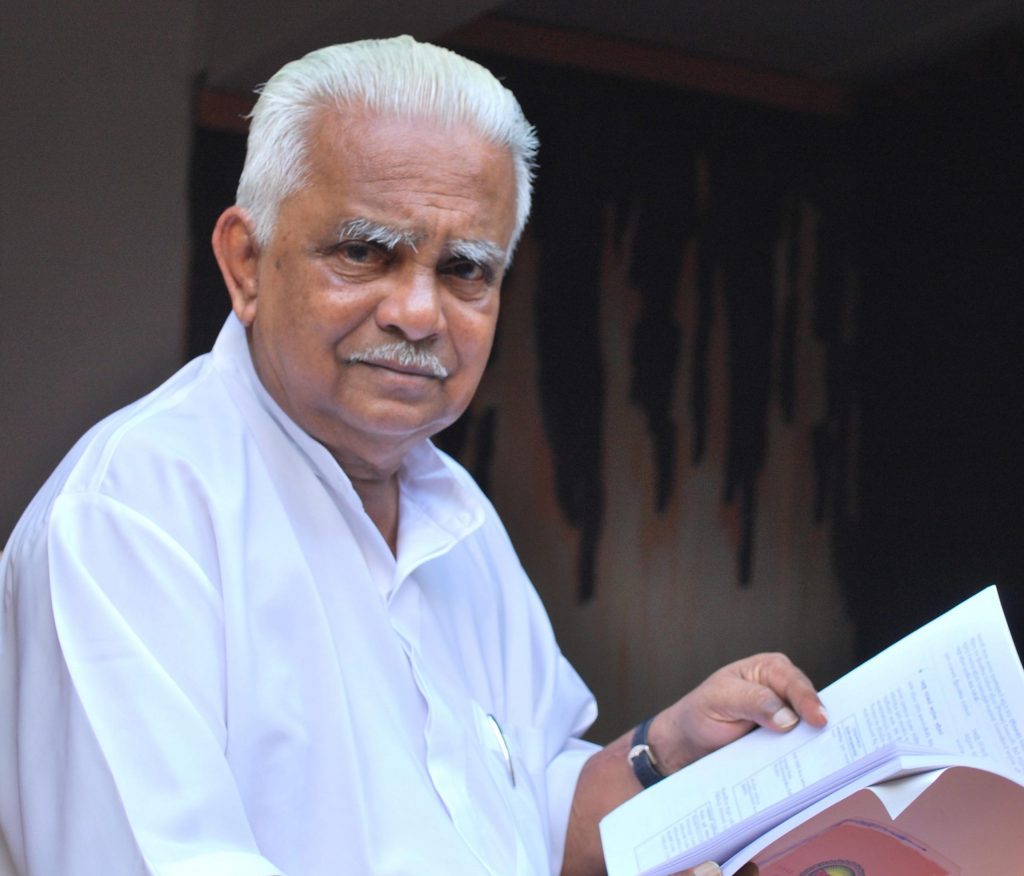
Dr. A. T. (Ahangamage Tudor) Ariyaratne, founder of the Sarvodaya Shramadana Movement of Sri Lanka—the oldest and arguably the largest Engaged Buddhist organization in the world—died on April 17, 2024, at a hospital in Colombo, Sri Lanka’s capital. He was 92. Though a devout Buddhist, Dr. Ariyaratne was widely hailed as “the Gandhi of Sri Lanka” for his pioneering peace and humanitarian work. Respected by political, cultural and religious leaders alike, he was accorded a full state funeral on April 20.
According to its website, Sarvodaya (Sanskrit for “the awakening of all”) Shramadana (“gift of labor”), founded in 1958, has as its mission to “create a no poverty, no affluence, and conflict-free society,” supporting the “total awakening and well-being of all (individuals, family, village nation, and the world).”
Dr. Ariyaratne was born in 1932 in Unawatuna, a village in the Galle District of what was then Ceylon, later graduating from Vidyodaya University with a degree in economics. He was teaching at Nalanda College, an upscale high school in Colombo, when, as an “educational experiment,” he took students and teachers from Nalanda to work alongside local residents of Kanatoluwa, a remote village, in building a road. This was the first of numerous “Shramadana camps” staffed largely by volunteers that helped local villagers across Sri Lanka overcome the ravages of poverty. Over the next six decades, the Sarvodaya Movement became an engine of rural empowerment, promoting economic development based on “six dimensions of awakening”—spiritual, moral, cultural, social, economic, and political. At Dr. Ariyaratne’s death, Sarvodaya’s model for self-reliance, community building, and sustainability had reached more than 15,000 underprivileged communities across Sri Lanka.
Dr. Ariyaratne’s influence also extended well beyond Sri Lanka. As a social activist whose work was grounded firmly in Buddhist teachings, he was an inspiration to Engaged Buddhists around the world. Buddhist teacher, author, and environmental activist Joanna Macy recalls being introduced to Dr. Ariyaratne during a visit to Sri Lanka in the late 1970s. “Gandhi had used the term [Sarvodaya] to mean the uplift of all,” she said, “but Ari added a distinctly Buddhist flavor to the name, using sarvodaya to denote both the awakening of all and the awakening of the whole person.” Macy spent a year, from 1979 to 1980, as a “participant-observer” of Sarvodaya’s work, joining the training for the organization’s village workers. Later, she attended peace meditations organized by Dr. Ariyaratne during the Sri Lankan civil war. She has credited his philosophy with influencing her own formidable peace and development work in the decades since.
For Dr. Ariyaratne, supporting Sarvodaya was an integral part of his Buddhist practice. In an interview for Tricycle’s 2008 issue, he said:
“Attaining full enlightenment is the goal of all Buddhists. So when I struggle hard to empower the poor, that work becomes the means through which I can attain personal enlightenment. The ten perfections, or paramitas—namely, giving, discipline, renunciation, wisdom, effort, patience, truth, determination, loving-kindness, and equanimity—can be cultivated when one honestly and diligently serves the poor.”
In a message after Dr. Ariyaratne’s death, his longtime friend Venerable Bhikkhu Bodhi, founder of the Buddhist Global Relief, remembered him as “not only a leader in the field of humanitarian service but a wide-ranging visionary who saw deeply into the need for an expression of the dharma that could meet the crucial demands of the contemporary world.” Although from the outset Sarvodaya was nonsectarian, welcoming people from all traditions, “the animating spirit was the teaching of the four noble truths, reformulated to address the problem of village poverty,” Bhikkhu Bodhi said. “Its moral bedrock was the ethic of selfless giving, nonviolence, and the four ‘divine abodes’ of loving-kindness, compassion, altruistic joy, and equanimity.”
In recent years, Dr. Ariyaratne had served as president emeritus of Sarvodaya, and, according to reports, the movement is continuing successfully under the guidance of his son, Vinha, one of his six children. Nonetheless, to many of his admirers, Dr. Ariyaratne’s death “will create a deep void in Sri Lanka’s civic society,” said Lionel Bopage. A former political dissident who at one time worked for SEEDS (Sarvodaya Economic Enterprises Development Services), Bopage remembers kindnesses extended by Dr. Ariyaratne at a time when Bopage was under threat for his antigovernment activities and Dr. Ariyaratne was himself a victim of government harassment.
Dr. Ariyaratne will not go unheralded. Among the many honors he had received for his work are the Gandhi Peace Prize from India, the Niwano Peace Prize awarded by Japan’s Niwano Peace Foundation, the Ramon Magsaysay Award for Community Leadership in memory of a former president of the Philippines, and several honorary degrees. In 2006, he was presented with Sri Lankabhimanya, Sri Lanka’s highest national honor.
Dr. Ariyaratne was also known for his writings on the spiritual foundation of Engaged Buddhism and the principles and practices of the Sarvodaya Movement. Sarvodaya USA has made available a digital library of his collected works free.

Thank you for subscribing to Tricycle! As a nonprofit, we depend on readers like you to keep Buddhist teachings and practices widely available.