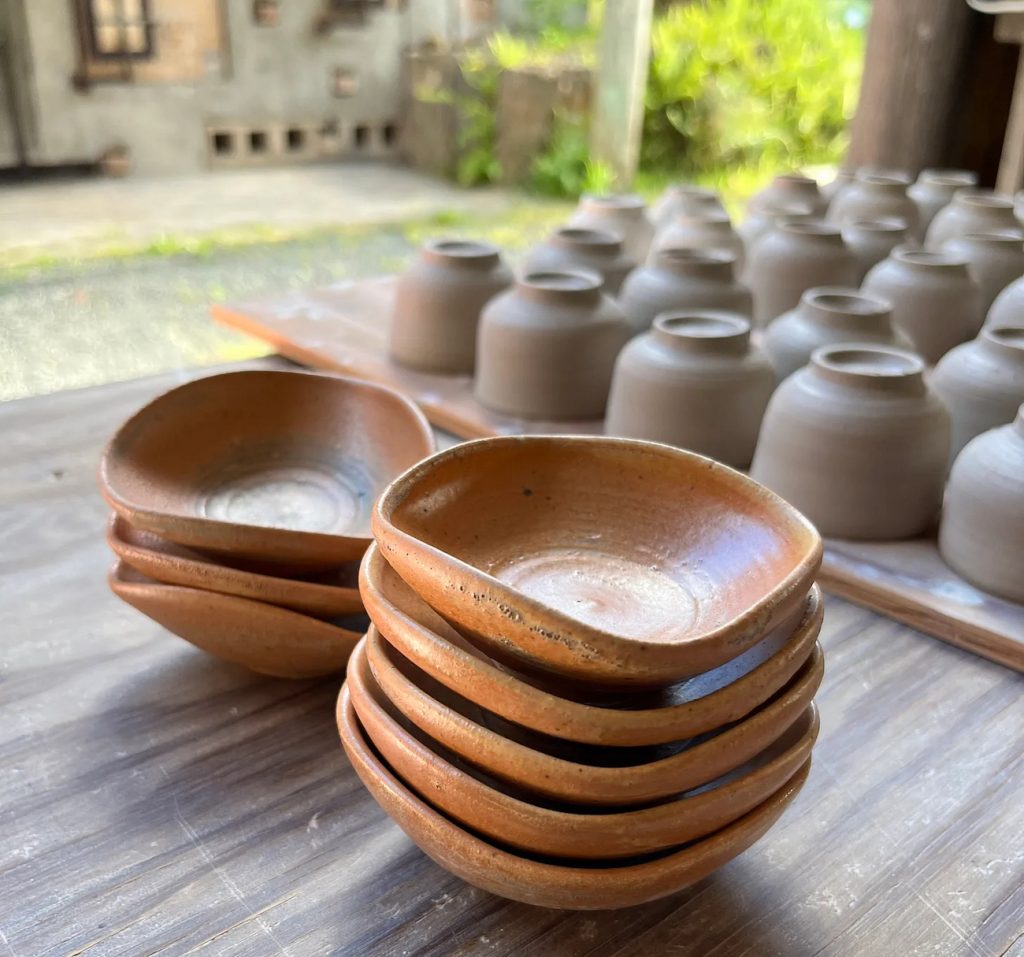
One of the first arts I trained in as part of living at Chozen-ji was ceramics. One weekend morning in 2018, I made my way back to the ceramics studio. There, I found several Dojo members puttering around and happy to show me the basics.
It would take months, if not years, to learn to tame a ball of clay on the potter’s wheel. It has taken me longer still to tease out how to approach elevating ceramics from more than making pretty pots into a Way to realize my True Self, a kind of Zen discipline.
Early on in my ceramics training, my first ceramics teacher, Daijo, came into the kitchen with some small bowls I’d recently thrown and then trimmed.
“Cristina,” he said. “You know your pieces? They’re pretty good… but they’re all kinda crooked.”
The thing about approaching the arts through Zen is that, by looking at any art as more than just an art but as a Way, you start to see how the state of your mind, body, and spirit is reflected in everything you do. The product of your art is a snapshot of the state of your mind in the moments of creation.
So, when Daijo told me that my ceramics were crooked, I was hit with the immediate understanding that my bowls reflected not just my skill in ceramics, but also something about me. In other words, not only were my ceramics crooked, I was crooked.
There were technical reasons for their crookedness, such as waiting too long to trim them so that, by the time I got to them, they were no longer leather hard but approaching bone dry. This makes the trimming blade skip and wobble. But this is too rational an explanation for what Daijo saw. As snapshots of the state of my mind, my body, and my spirit at the moment of their making, my little ceramic bowls showed something deeper.
The product of your art is a snapshot of the state of your mind in the moments of creation.
All of the rich and varied feedback that’s a part of Zen training told me the same thing. Because of my habits and attachments, I was far from my True Self. I was already me, of course, and perfectly so, but also just a little off.
At the end of last year, Takashi Nakazato came to Chozen-ji. He’s a 13th generation master potter from Kyushu whose father was a Japanese national treasure. For hundreds of years, his family has been making ceramics in a unique style called Karatsu-yakimono or Karatsu-yaki. Of the many families once making Karatsu-yaki, Nakazato Sensei’s is the only one left. As soon as Nakazato Sensei demonstrated his method of making ceramics, I recognized immediately that it was approaching a Way.
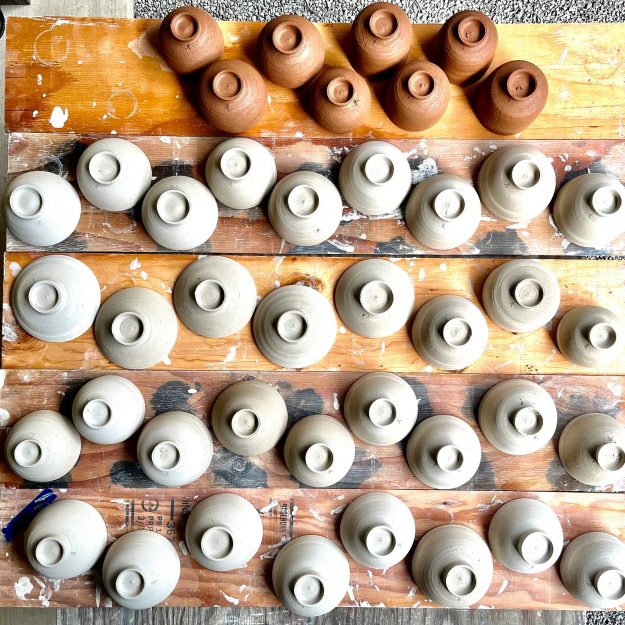
Nakazato Sensei likes to chide other potters, saying, “Everyone thinks they’re an artist.” Instead of trying to make art, he says, we should just make things that are useful. And we should make lots of them.
“Cristina, you know mu shin?” he once asked me, using the Japanese Zen phrase meaning Void Mind or No Mind. “Make 500 pieces a day,” he continued, referencing the fact that, for much of his life as a potter, he made 500 pieces a day, every day, “and: mu shin.”
Today, I spend much of my time making the same form over and over again in ceramics using Nakazato Sensei’s method. The form he assigns all beginners to make is a small plate, the kind in which Japanese pickles and side dishes are served. Sensei says that when I have mastered this form, I’ll be able to make anything. And I can confirm that, whenever I do venture off to make something else—a bottle, tea bowl, plate, or water container—I can see clearly that my sensitivity and strength in handling the clay has grown.
And so I keep making these little plates, hitching my breath, posture, and concentration to shape the clay. As time passes, I continue to see myself reflected back in these small plates, which is to say that they are more straight, upright, sturdy, and striking—but still have a lot of room for improvement.
♦
Originally published on Cristina Moon’s Substack. Reprinted with permission.

Thank you for subscribing to Tricycle! As a nonprofit, we depend on readers like you to keep Buddhist teachings and practices widely available.