Last April, my morning meditation was interrupted by the sounds of whirring chainsaws and clamoring trucks. When I stepped to the window, I noticed three men from the New York City Department of Parks and Recreation standing around a large oak tree on the sidewalk in front of my apartment. At first, I thought they were trimming the branches. As I watched them saw off larger and larger sections, I realized they were cutting down the entire tree.
My heart started racing. How could I stop this? I thought of the environmental activist Julia Butterfly Hill, who climbed a California redwood tree in 1997 and lived there for nearly two years to save it from being cut down. From my third floor window, I quickly scanned the oak’s upper canopy. It was nearly gone.
I hurried down to the sidewalk and approached the hard-hatted men. “Why are you cutting it down?” I yelled over the chainsaws. A bearded man with icy blue eyes cupped his hand around his ear and leaned toward me. I repeated my question.
He raised his arm and gestured toward the tree, yelling: “It’s dead!” His tone suggested that I had missed something obvious. Dead? The day before I had watched house sparrows and black squirrels scamper along the branches and hide among the tree’s full, healthy leaves. We watched as a thick limb tumbled down through the remaining branches and landed on the street with a thud.
Related: The Bird’s Song
As much as I wanted to intervene, there was nothing I could do. I trudged back upstairs. I closed my apartment windows, but I couldn’t escape the screaming chainsaws. Later, after the trucks pulled away, all that remained was a clean stump and a few small piles of sawdust.
For days, I reflected on my urge to protect the tree every time I walked past the stump. I realized I was trying to repay a kind of guardianship offered to me a long time ago. When I was a kid, three tall and sturdy oak trees grew in my family’s backyard. When I reached my hand out of my open bedroom window, I could graze the tips of their leaves with my fingertips. At night, I remember lying in bed and watching their dark branches sway in and out of the window frame. I liked to think they were waving hello, like witnesses or guards watching over me in the night.
In Buddhism, trees have long been recognized as living things worthy of recognition and protection. Shakyamuni Buddha was born in the lush Lumbini grove and later became enlightened under a bodhi tree. At the end of his life, he also physically passed (parinibbana) while nestled in a grove of sal trees. In Thailand, forest monks perform tree ordination ceremonies as a way to declare trees sacred and conserve the forests. Monks wrap robes around ordained trees and hang signs on their vast trunks that remind others that “to harm the forest is to harm life.”
A meditation teacher once advised me to look to the example trees set as steady, observant beings. “They are excellent meditators,” she said. “They sit in one spot for decades, watching all that goes by.” In his book The Island Within, anthropologist Richard Nelson described trees in a similar manner. “The dark boughs reach out above me and encircle me like arms. I feel the assurance of being recognized, as if something powerful and protective is aware of my presence . . . I am never alone in this forest of elders, this forest of eyes.”
I sometimes wonder if the stories we impose on trees—and the anthropomorphic qualities we assign them—illuminate our efforts to bring forth the parts of ourselves that are most curious and aware. Not too long ago, I was strolling through a museum with a friend. Her husband had passed away several weeks earlier, and she was grieving and in deep shock. After we stopped to rest on one of the couches in the museum, we gazed out the windows at several small trees growing on a patio.
As we watched the wind whip the thin branches, I remembered something I had once read about yew trees. This particular type of tree hollows out as it ages, which is actually a key survival tactic: an empty, perforated column is less likely to be blown down in a gale than a solid, heavy trunk. I shared this with my friend, who said nothing in response. Beyond the patio, the glass windows of a lower Manhattan building reflected the city’s glittering twilight skyline.
After a few moments, she asked in a quiet voice, “Doesn’t their hollowness make them more fragile?” We sat in silence for a few moments. My friend took a deep breath, sat back against the couch, and closed her eyes.
Related: My Stoop Sangha
A deeply felt experience of fragility provides an acute understanding of the self as breakable. Over time, this insight can eventually reveal an absence of self. Nagarjuna, the founder of the Madhyamika school of Buddhism, taught that this absence of self—this emptiness—is not a thing that we can feel. It is, rather, more of a vehicle to help us understand our intrinsic connectedness with all things. This teaching can remind us that even though we may feel alone or isolated at times, we are not.
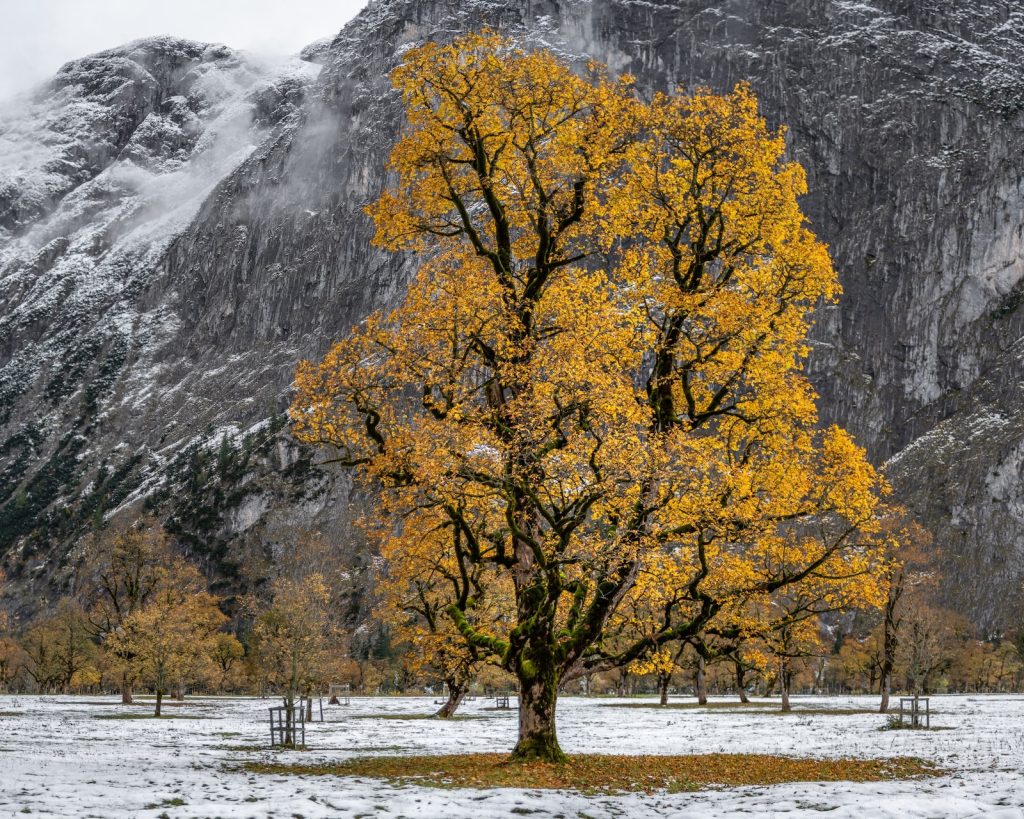
The word guardian derives from the Middle English word garden. I find this fitting; my instinctive need for protection leads me to nature—to plant life—and almost always to trees. When I’m in their presence, I can sense their watchfulness. I feel their embrace.
I want them to know the feeling is mutual. The trees wave hello to me, and I wave back.
This article was originally published in 2017.

Thank you for subscribing to Tricycle! As a nonprofit, we depend on readers like you to keep Buddhist teachings and practices widely available.