The First Noble Truth: Suffering

The retreat on Twitter

Clark Strand's week 3 follow-up video on Green Meditation is on YouTube #retreats http://3.ly/0495
12 hours 13 min ago
Clark Strand's Q&A from Week 2 of his Online Retreat has been posted! #retreats http://3.ly/a465
1 day 14 hours ago
Week 7 of Gelek Rimpoche on the 4 Noble Truths and Week 3 of Clark Strand on Green Meditation both begin today! #retreats http://3.ly/z4gO
2 days 13 hours ago
Gelek Rimpoche Week 6: Irritation is everywhere, but make sure irritation doesn't take you over and become anger. #retreats http://3.ly/H33e
5 days 9 hours ago

About Gelek Rimpoche

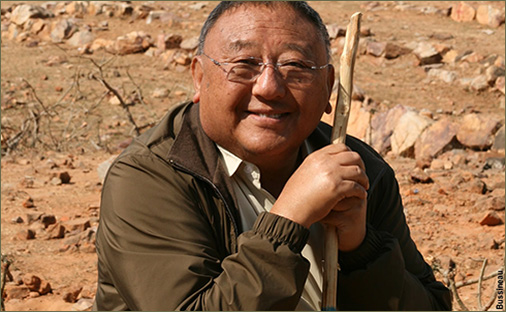
Gelek Rimpoche is one of the last great living Tibetan Buddhist masters to be fully educated in old Tibet. He is known for his knowledge of Tibetan Buddhism, culture and history. Since the late 1980s, he has given thousands of lectures and presentations to Westerners.

Discussion Leaders

Mark Magill is a contributing editor to Tricycle. His non-fiction work includes Why Is the Buddha Smiling? (Far Wind/Godsfield, 2003). He was a collaborator with Gehlek Rimpoche on Rimpoche's book Good Life, Good Death (Riverhead, 2001). He divides his time between New York City and the Catskill Mountains, where he keeps bees and serves as a member of the North Branch Volunteer Fire Department.

Hartmut Sagolla has been a student of Gelek Rimpoche since 1984. After living in a Dharma Center in Australia with Geshe Thubten Loden he moved to Ann Arbor, Michigan in 2002 to work with Rimpoche as Program Co-Director of Jewel Heart, organizing and teaching classes, courses and workshops, guiding meditation retreats and transcribing and editing Gelek Rimpoche's teachings.

Discuss the retreat with Senior Students

Gelek Rimpoche says that even what we ordinarily call happiness is in fact suffering. Why can't we say simply that happiness and suffering both exist, and that we have to expect both?

The First Noble Truth: Suffering

Use this form to ask Gelek Rimpoche a question. Gelek Rimpoche will answer selected questions from among those submitted by noon EST on the Wednesday following the teaching. A recording of the selected answers will be posted on the Monday following.

The First Noble Truth: Suffering

Your question has been submitted. You can hear Gelek Rimpoche answer selected questions on the Monday following the teaching.

If you would like to discuss the teachings with fellow retreatants, close this window and leave a comment under the video.

Comments

Shalom from Jerusalem.

Thank you for your teaching. I wonder if it is possible to either include transcription in the audio talk, or have a script available, so I can understand more clearly and fully.

Thank you.

Mark Magill's picture
Discussion
Leader

That's an excellent idea.  Thank you. I'm asking the editors to look into that right away.  

great--thanks for checking this out so quickly....there is so much to learn!

Ellen from Jerusalem

I hope the editors will look favorably on that.  I am a little hard of hearing and sometimes have to rely on printed text when I am unable to understand a speaker.

We'll get on it and post the first talk soonest.

Thank you Rinpoche! You wonderfully illustrated the biggest problem I have. That is being willing to feel the pain and suffering I experience and to be aware of how much I distract myself and try to remain comfortable away from the sufferings of life. How can we break through the denial without having to wait until the pain becomes so great that we have no choice but to notice?

My daughter has died in a car crash.

The Buddha said there is suffering in all households.

My meditation helps me be aware of my life and to experience a stillness

at the center of myself and the universe. I believe my daughter's "I AM"

has returned to this stillness, or source, having dropped her mind and body.

Is my understanding correct. Does Buddhism offer more to help me with my pain?

Mark Magill's picture
Discussion
Leader

reply to ted dixon: I once asked Gelek Rimpoche about how he felt about losing his friends, parents, teachers, even his homeland.  He said that of course he felt sad and missed them. Not to feel that way would not be human.  But he also said that when he thinks about those close to him whom he's lost, he thinks about how fortunate he was to have known them, been close to them and appreciate them for all their good qualities.  

Suffering like anything else comes in all shades. Life is suffering and suffering is life. Our whole life, beginning at birth, revolves around trying to obtain complete satisfaction or happiness. An impossible goal because our desires are never completly met. If we think they are it is only for a short time before that sense of satisfaction begins to fade. I have been studying and practicing Buddhism for about 12 yrs and I have to say that the path is difficult. It is not easy swimming against the current. Sometimes I make a little progress only to be swept back again. But I keep trying because to give up is to drown.

Thank you for this teaching.  And thank you for taking part in tricycle's retreat series!  I live in a somewhat isolated area where hearing the Dharma is not easily accomplished.  Making the teaching available in this way is a big help!

Mark Magill's picture
Discussion
Leader

reply to steveinmo:  Thanks.  That's great to hear.  

I am concerned that as I change my life to solve the problem of suffering that it may cause pain in my family.  I suspect my spouse fears this as well.   

JC

Mark Magill's picture
Discussion
Leader

reply to flyrcairplanes:  How do you think changing your life to solve the problem of suffering might cause pain in your family?  It might reduce negative attachments, but at the same time, the goal is to remove the obstacles to appreciation, love and compassion.  None of those results are intended to cause pain in others.

our 20 year old son was murdered 36 years ago. He was a vegan, ( would not wear leather starting at age of 9) and seemed to do everything right. Joseph, Jack and Sharon helped me and their 3 month retreat allowed me to come out the other end of the tunnel. The absolute Blessing was, and is: he was doing what he wanted to do and their was no unfinished business between us. His death brought our 3 other children together in a way that nothing else ever could.((they annually, and privately, (letting no other relative attend), celebrate his life)), My spouse and I still weep but we do so with great joy. He wanted to be a teacher - he did not know that he was and is! 

addition: At the time of his death our son was a college volunteer working with parolees and was killed by one. I was an administrator in a Maximum security prison. Whenever I gave a public talk I spoke forcefully against the death penalty and J. Edgar Hoover's ideas about juvenile delinquency. When Thomas died I had to reevaluate my ideas about punishment. Actually, it was a no-brainer; I only had to consider deeply how our son would feel and I continued my public protestations.

t e tunney

We see so much suffering in ourselves and externally, yet we cannot comprehend suffering as what Buddha mentioned "Dukkha is to be comprehended." Can Rinpoche help to give some advice as to how we see suffering to end (or desiring to end) suffering? 

Hartmut Sagolla's picture
Discussion
Leader

If you continue to follow Rimpoche's next videos you will probably get your answer from him directly. But briefly speaking it is a step by step process along the Four Noble Truths. The First Noble Truth is to realize that suffering or dukkha pervades all our lives - as Rimpoche had mentioned in the first video. Even our perceived pleasures are mostly nothing but the replacing of one form of suffering with another. By acknowledging the reality of suffering at all different levels we are then motivated to become free from it. We develop the desire to be free from all these suffering - not just from the obvious physical and emotional pains but also the changing suffering and pervasive suffering. Then the next step is to find the causes of suffering (The 2nd Noble Truth) and by knowing these we are then able to eliminate the causes and then suffering can be ended (The Third and Fourth Noble Truth). t Rimpoche will explain all that in more detail in the next videos. 

I am unable to access the retreat video.  The picture comes up but seems to stall.  I had no trouble with the previous retreat. Has anyone else reported this?


I have that problem often with all sorts of videos (including YouTube's)..what i've found helpful is to let the video struggle through to conclusion while i'm off doing something else during the time it takes. Once it has played in it's entirety, it should be fully buffered so you can just click and hold onto the moving indicator and pull it back to the beginning...let it go...see if that works for you....

metta, ike

Hartmut Sagolla's picture
Discussion
Leader

No, didn't have that particular technical problem. I am going to forward this to the tech people and they will get back to you..


Hartmut Sagolla's picture
Discussion
Leader

we haven't had this particular technical problem so far. I will forward you to a technical person at Tricyle. 

I too am having trouble viewing the last half of the dharma talk, but I will wait for it to buffer and see if I can hear it later. Thanks so much for offering these teachings in this format. As a mother of young children, it is difficult to attend dharma talks or get away for retreats. Now, at any time I have free, I can listen!

Metta, Candace

Greetings,

Can anyone help me to load these videos onto my iTunes and my iPod?

Thank you

peace and blessings

evan

Thanks so much for posting the transcipt of the first session--this was very helpful to understand your teachings.

Will you be posting transcripts for the following sessions, as well?

Ellen from Jerusalem

Hi Ellen,

We will be posting transcripts for the other talks.  The 2nd talk transcript should be ready by Friday or Monday.

Monty

Tricycle

That's great, Monty. Thanks for the effort!

Ellen

Reproduction of material from any Tricycle pages without written
permission is strictly prohibited. ©2010 Tricycle.com

Tricycle: The Buddhist Review
92 Vandam Street, New York, NY 10013
Subscription Inquiries 800.873.9871 | Advertising Inquiries 510.548.1680 | Editorial Inquiries 212.645.1143 | Fax 212.645.1493

For Sustaining Members and Digital Subscribers Only

Tricycle Online Retreat content is available to Tricycle Community Sustaining Members and Tricycle digital subscribers only. If you'd like to become a Sustaining Member, please click here.

Learn more about Tricycle Sustaining Membership

Already a Member? Log in here